
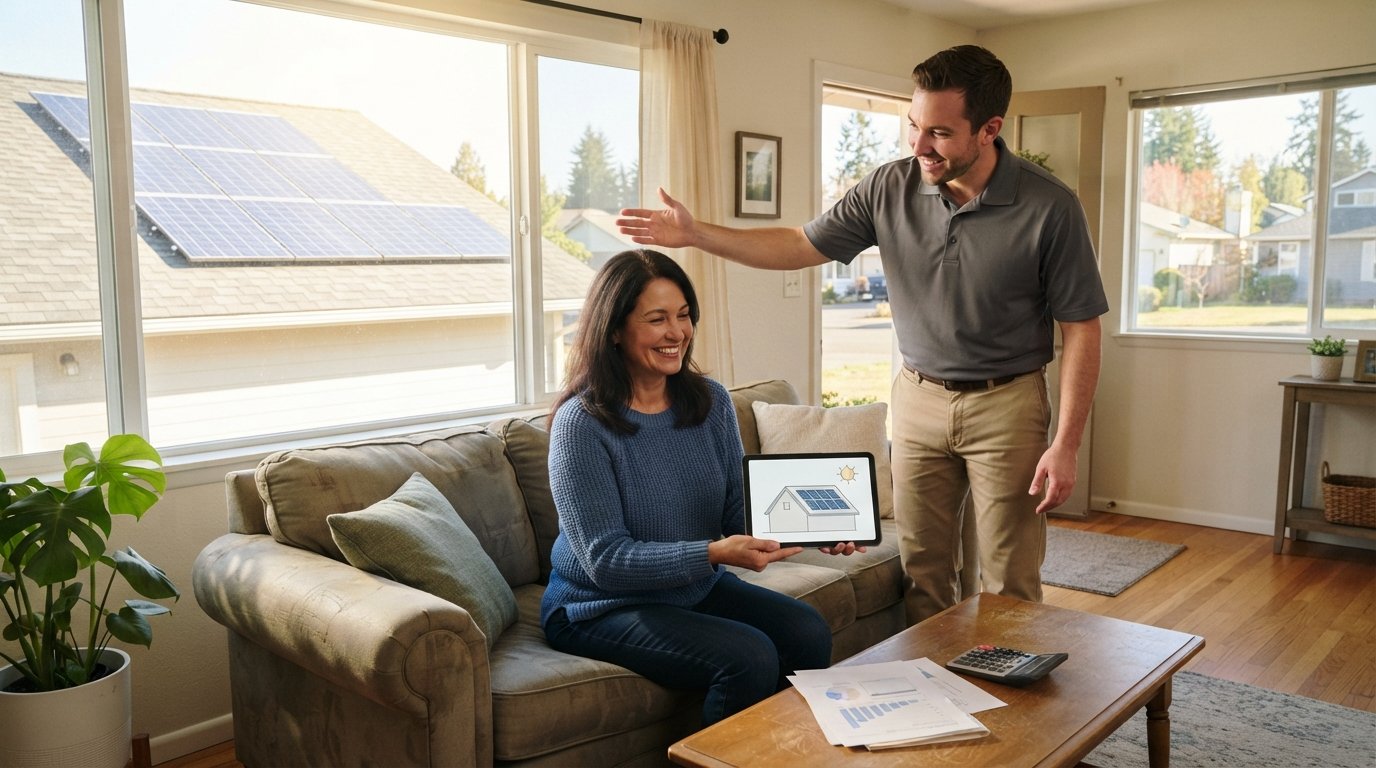
Solar Financing for Low Income Homeowners: Assistance Programs
Low income homeowners can now access solar financing assistance programs that slash upfront costs and cut monthly bills. Learn how to qualify and save.

By Liam Parker
Learn more about Solar Panel Installation and Repair for guides, costs, and what to expect.
Compare Solar Panel Installation and Repair Pros Near You

Enter your ZIP code to compare top-rated local professionals and request free quotes.
For many low income homeowners, the dream of slashing monthly electric bills with solar panels has felt out of reach. The upfront cost of a residential solar system can easily run between $15,000 and $30,000, a figure that looms large for households already stretching every dollar. Yet a quiet revolution is underway: a growing network of solar financing low income homeowners assistance programs is breaking down these financial barriers. These initiatives blend federal grants, state-level rebates, nonprofit support, and innovative loan structures to make solar ownership not just possible, but genuinely affordable for families earning less than 80% of their area's median income.
This article is your road map. We will walk through the most effective assistance programs, explain who qualifies, and show you how to layer multiple forms of aid to reduce your out-of-pocket cost to near zero. Instead of merely dreaming about energy independence, you can take concrete steps this year. The key is understanding that assistance is not a single handout; it is a stack of strategies, and we are going to help you build that stack.
The True Cost Barrier and Why Assistance Matters
Low income households often pay a disproportionate share of their income on energy, sometimes up to three times more than higher earners, according to energy justice research. This phenomenon, often called the energy burden, means that a high monthly utility bill is not just an inconvenience; it is a constant financial drain that limits savings, healthy food choices, and other essentials. Solar panels directly attack this problem by generating your own electricity, but only if you can clear the initial installation hurdle. That is exactly where targeted assistance programs step in.
Without help, a typical low income family might wait a decade or more to save enough for a cash purchase. Traditional solar loans often require credit scores above 650 and stable income, which can exclude those with lower scores or irregular wages. Even solar leases, which require no upfront cost, usually come with credit checks and long-term contracts that can be risky if you move. Assistance programs flip this model: they provide grants that do not need repayment, subsidies that reduce the price, and specialized loans with zero-interest terms and flexible underwriting.
Key Programs You Should Know About
Several federal and state programs directly target low income homeowners. The most powerful current option is the Solar for All grant, funded by the Environmental Protection Agency (EPA) under the Inflation Reduction Act. This program allocates $7 billion to states, tribes, and nonprofits to expand solar access in low income and disadvantaged communities. Depending on where you live, Solar for All may cover a significant portion of your system's cost, sometimes 50% or more, with some projects reaching 100% coverage for qualifying households.
Another critical resource is the Low Income Home Energy Assistance Program (LIHEAP), which historically helped with heating and cooling bills. In recent years, several states have begun allowing LIHEAP funds to be used for weatherization and energy efficiency upgrades that include solar-ready improvements. While not a direct solar subsidy, LIHEAP can pay for roof repairs or insulation that makes solar installation possible and more effective.
You should also explore state-level programs, which vary widely. California's Disadvantaged Communities Single-family Solar Homes (DAC-SASH) program offers free solar systems to income-qualified homeowners. Massachusetts has the ConnectedSolutions and SMART programs, which provide adders for low income customers. New York's Affordable Solar Program offers a per-watt incentive. To find what is available in your state, search for your state energy office and the term "solar for low income." You can also use the Database of State Incentives for Renewables & Efficiency (DSIRE) to filter by state and technology.
How to Qualify: Income Limits and Other Requirements
Qualification for solar financing low income homeowners assistance programs typically hinges on three criteria: income, homeownership, and property condition. The most common income benchmark is 80% of the Area Median Income (AMI), which is calculated by the U.S. Department of Housing and Urban Development (HUD). For example, in a county where the median family income is $70,000, a household earning less than $56,000 would likely qualify for most programs. Some initiatives, like the Solar for All grant, may use a more generous threshold of 80% of the State Median Income, and some community programs extend to 60% or even 50% of AMI.
Homeownership is usually a non-negotiable requirement because you must own the roof and the property to install panels. You will also need a structurally sound roof with at least 10 to 15 years of life left, as solar panels last 25 to 30 years. If your roof needs replacement, some programs can bundle that cost into a zero-interest loan, or you may be able to use LIHEAP funds for the roof repair. In addition, your home must have sufficient sun exposure, free from excessive shading from trees or other buildings. Finally, you will likely need to be current on your property taxes and have no outstanding utility debts, though some programs offer debt forgiveness as part of the application.
Layering Assistance to Achieve $0 Upfront
The real magic happens when you combine multiple forms of assistance. A typical low income homeowner might start with a Solar for All grant that covers 40% of the system cost. Then, a state-level rebate could shave off another 20%. You might also qualify for the federal Investment Tax Credit (ITC), which is worth 30% of the remaining cost, though you need taxable income to claim it. For many low income families, the ITC is not directly usable, but you can transfer the credit to a third-party financier who buys it from you in exchange for a lower system price. This is called "elective pay" or "direct pay," and it was made easier under the Inflation Reduction Act.
After applying all grants and rebates, you might be left with a residual cost of 10% to 20%. That is where specialized low income loans come in. These loans often feature 0% to 2% interest rates, no credit score requirement, and repayment terms of 20 to 25 years. Some programs even offer principal forgiveness if you stay in the home for a certain period, such as a 20% reduction for every five years you own the system. The result: you can go solar with zero dollars out of pocket, and your monthly loan payment might be less than the electricity bill it replaces. In fact, the Department of Energy estimates that low income solar projects can reduce energy burdens by 20% to 30% on average.
Finding and Applying for Assistance
Navigating the application process can feel overwhelming, but it is manageable if you follow a structured approach. Here is a step-by-step guide to get you started:
- Confirm your eligibility. Use the HUD AMI lookup tool to find your county's median income and calculate your household's percentage. Gather your recent tax returns, pay stubs, and utility bills.
- Search DSIRE and state resources. Go to the DSIRE website, select your state, and filter for "Low Income" and "Solar." Also check your state energy office's website for specific program announcements.
- Contact your local Community Action Agency. These nonprofits often administer LIHEAP and weatherization programs and can guide you to solar-specific assistance in your area.
- Get a professional solar assessment. You need to know your roof's condition and sun exposure. Many assistance programs require a site assessment before you apply.
- Apply for all relevant programs simultaneously. Because funding is limited and often first-come, first-served, do not wait. Fill out complete applications and keep copies of everything.
- Work with a vetted installer. Choose a solar company that has experience with low income programs. They should help you navigate the paperwork and connect you with financing partners.
One common mistake is assuming you do not qualify because you have a low credit score. Many assistance programs intentionally do not use credit scores as a primary criterion, focusing instead on income and homeownership. Another mistake is waiting for a perfect time; incentives can expire or funding can run out. The best time to apply is now, even if you are still in the exploratory phase.
Community Solar and Other Alternatives
If your roof is not suitable for solar, either due to age, shading, or structural issues, you are not out of options. Community solar allows you to subscribe to a shared solar farm and receive credits on your utility bill, with no installation on your property. Many community solar projects reserve a portion of their capacity for low income subscribers, offering discounted rates or no upfront fees. In states like Minnesota, New York, and Massachusetts, community solar is a thriving market, and you can often subscribe with just a social security number and a utility account.
Another alternative is a solar lease or power purchase agreement (PPA) specifically designed for low income households. These are third-party ownership models where you do not own the panels but pay a fixed monthly rate for the electricity they generate. While these contracts historically had credit score requirements, some new programs have relaxed them, especially when the homeowner participates in a workforce development or energy assistance program. Always read the contract carefully to understand annual escalator clauses and what happens if you sell your home. A reputable installer will explain your exit options, including buying out the system or transferring the lease to the new owner.
The Role of Nonprofits and Community Groups
Nonprofit organizations are often the unsung heroes in this space. Groups like GRID Alternatives have installed free or deeply discounted solar systems for thousands of low income families across the country, using a volunteer workforce and donated equipment. They also offer job training, which can be a pathway to employment in the solar industry. Similarly, local community development financial institutions (CDFIs) offer affordable loans and technical assistance to homeowners who do not qualify for traditional bank financing.
You can also reach out to faith-based organizations, housing authorities, and rural electric cooperatives. Many cooperatives, especially in rural areas, have started community solar programs with low income set-asides. For example, the Kit Carson Electric Cooperative in New Mexico has built a community solar array that serves low income members with discounted rates. These local initiatives often have the most flexible requirements and the least red tape, so they are worth a phone call.
How to Verify Incentives and Avoid Scams
As demand for solar assistance grows, so does the risk of scams. Be wary of any company that guarantees a free solar system with no paperwork or asks you to sign a document before you have received a full explanation. Legitimate programs will always require proof of income, a homeownership verification, and a site assessment. You should never pay an upfront fee to apply for a government grant; the application process is free.
To verify an incentive, always cross-reference with official sources. The IRS website has details on the ITC and elective pay. Your state energy office publishes program details and often has a hotline for questions. The DSIRE database is maintained by the North Carolina Clean Energy Technology Center and is considered a reliable source. If you are working with an installer, ask for references from other low income customers and check their Better Business Bureau rating. A legitimate installer will be happy to explain how the financing works and will never pressure you to make a same-day decision.
Additionally, remember that the federal ITC is a tax credit, not a rebate. You must have federal income tax liability to claim it directly, but you can transfer it to your solar installer or a third-party financier through a mechanism called "transferability." This transfer can lower your upfront cost by thousands of dollars. Always ask your installer how they handle the ITC and whether they will pass the savings on to you in the form of a reduced purchase price.
Your Next Step: Free Quotes and Personalized Guidance
You now have a clear picture of the landscape. The next action is to see what is possible for your specific home and budget. The best way to do that is to request free, no-obligation quotes from vetted solar installers who specialize in low income programs. A professional installer will conduct a site assessment, review your utility bills, and help you identify which grants and rebates you qualify for. They can also connect you with financing partners that offer zero-interest loans.
When you receive quotes, compare them carefully. Look at the total cost, the equipment quality, the warranty terms, and the financing options. Ask each installer to show you a breakdown of all incentives applied. A good quote will clearly list the gross system price, the federal tax credit, any state or utility rebates, and your final out-of-pocket cost. If one quote is significantly lower than others, ask why; it could be a great deal or a sign of inferior equipment. Also, check if the installer is certified by the North American Board of Certified Energy Practitioners (NABCEP), which is a mark of professionalism.
You can start by reading our solar financing options for homeowners in 2026 guide, which explains loan types and leasing in more detail. For a deeper dive into how solar can dramatically reduce your power bills, explore resources like SolarEnergy.ai, which offers independent analysis of solar savings and system performance. Their tools can help you project your long-term savings and compare different system sizes.
Solar in Your State: Regional Variations
Because solar financing low income homeowners assistance programs are often administered at the state level, your experience will depend heavily on where you live. In sunny states like California, Arizona, and Florida, the combination of high electricity rates and strong solar resources makes assistance programs especially impactful. For example, California's DAC-SASH program has funded over 8,000 systems, and the state's new Solar on Multifamily Affordable Housing (SOMAH) program is expanding to low income renters. Arizona has a Solar for Schools program, but its low income residential assistance is less robust, so you may need to rely more on federal grants and community solar.
In Texas, the market is deregulated, which means you can choose your electricity provider. Some providers, like Green Mountain Energy, offer low income solar plans, and the state has a Property Assessed Clean Energy (PACE) program that allows you to finance solar through a property tax assessment, which can be transferred to a new owner if you sell. However, PACE loans often have higher interest rates, so use them only if you cannot qualify for other financing. In the Northeast, states like New York and Massachusetts have some of the most generous low income solar incentives, including upfront rebates and performance-based payments. If you live in a state with less robust programs, you can still benefit from the federal ITC and from community solar, which is available in most states.
To maximize your chances, do not limit yourself to a single program. Apply to everything for which you are eligible. It is not unusual to stack a federal grant, a state rebate, a utility incentive, and a low interest loan. The combined effect can reduce your payback period to under five years, and your monthly savings will often exceed your loan payment, putting cash back in your pocket from day one.
Finally, remember that solar panels increase your home's value. A study by Zillow found that homes with solar panels sell for 4.1% more on average. For low income homeowners, this equity boost can be a game-changer, providing a path to future financial stability. Even if you plan to stay in your home for the long term, solar is a wise investment that pays dividends for decades.
Take the first step today. Request your free quotes, gather your documents, and start the application process. The sun is shining, and with the right assistance, it can power your home and your wallet.