
Perovskite Bifacial Solar Panels: The 2026 Breakthrough Guide
Perovskite bifacial solar panels are set to reshape the market in 2026, offering 30-40% higher energy yield and a faster payback period than standard panels.

By Caleb Morgan
Learn more about Solar Panel Installation and Repair for guides, costs, and what to expect.
Compare Solar Panel Installation and Repair Pros Near You

Enter your ZIP code to compare top-rated local professionals and request free quotes.
The solar industry is on the cusp of a revolution that promises to redefine how we capture the sun's energy. While traditional silicon panels have dominated rooftops for decades, a new class of photovoltaic technology is emerging from laboratories and pilot lines, poised to shatter efficiency records and lower costs further. These are the perovskite bifacial solar panels, and by 2026, they are transitioning from experimental curiosities to commercially viable powerhouses. For homeowners and businesses considering solar, understanding this shift is not just an academic exercise; it is a strategic move to future-proof an investment that will generate power for the next 30 years or more. This guide explores the convergence of these two cutting-edge technologies, what it means for the market, and how you can prepare for the next wave of solar adoption.
The convergence is more than a simple additive improvement. Think of it as a fundamental upgrade in solar panel architecture and materials. Perovskite, a crystalline material named for its original discovery in Russia's Ural Mountains, offers exceptional light absorption properties that can be tuned to capture different wavelengths of light. Bifaciality, on the other hand, allows a panel to generate electricity from both its front and back surfaces, harnessing reflected light from the ground, rooftops, or nearby surfaces. When combined, these technologies have the potential to achieve energy yields that are dramatically higher than today's best single-sided, single-junction silicon panels. Let's examine what makes this combination so powerful and what it means for your next solar project.
The Two Pillars: Perovskite and Bifacial Design
To truly grasp the significance of this technological leap, it is helpful to break down the two core components that are making it possible. Each represents a significant departure from the status quo of solar manufacturing and performance.
Perovskite: The Efficiency Disruptor
Perovskite solar cells are built using a unique crystal structure that is remarkably efficient at converting sunlight into electricity. Unlike silicon, which requires a thick, energy-intensive manufacturing process, perovskite can be produced using simpler, lower-temperature methods, often in a liquid form that can be printed or coated onto a substrate. This not only reduces manufacturing costs but also opens the door for flexible and lightweight solar panels. More importantly, perovskite cells can be engineered to absorb a broader spectrum of sunlight than silicon alone. In a configuration known as a tandem cell, a perovskite layer is placed on top of a silicon layer. The perovskite layer captures high-energy blue and green light, while the silicon layer captures the lower-energy red and infrared light. This layered approach has already led to laboratory efficiencies exceeding 33%, a figure that silicon alone can only dream of approaching.
The year 2026 marks a critical inflection point for perovskite technology. For years, the primary hurdle was stability and longevity. Early perovskite cells degraded quickly when exposed to moisture, heat, and ultraviolet light. However, significant research and capital have been poured into solving these durability issues. Encapsulation techniques, new material formulations, and advanced manufacturing processes have dramatically improved the operational lifespan of perovskite-silicon tandem cells. While they may not yet match the 30-year warranty of top-tier silicon panels, the gap is narrowing rapidly, with many manufacturers now targeting a 25-year useful life for their tandem products, which is a major milestone for commercial acceptance.
Bifacial: Capturing the Sun's Reflection
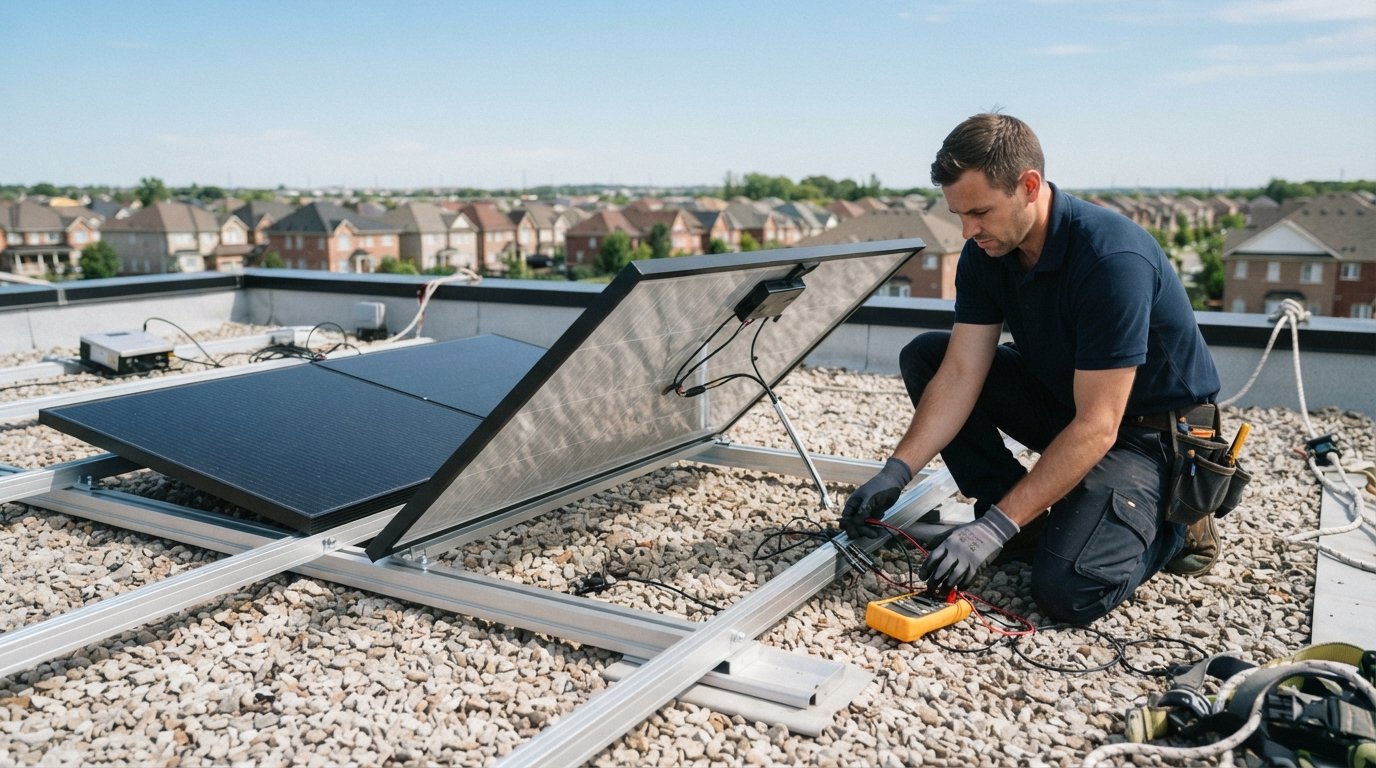
Bifacial solar panels are not new, but their adoption has been steadily increasing, particularly in the utility-scale market. The concept is simple: instead of having an opaque backsheet, bifacial panels use a transparent backsheet or dual-glass construction, allowing light to pass through the panel. A portion of that light is then reflected off the surface below (be it a white rooftop membrane, light-colored concrete, or even high-albedo gravel) and absorbed by the solar cells on the backside of the panel. This can boost energy production by anywhere from 5% to 30% depending on the installation's mounting height, tilt angle, and the reflectivity of the ground surface. For ground-mounted systems, this is particularly effective, but it also holds promise for commercial flat rooftops with reflective roofing materials.
The marriage of perovskite and bifaciality is a natural progression in solar design. The high efficiency of perovskite tandem cells on the front side captures the direct and diffuse sunlight, while the bifacial design recovers energy from the reflected light that would otherwise be lost. This dual-action capability is what makes the combined technology so compelling for maximizing the energy yield per square foot, a crucial metric for both space-constrained residential rooftops and sprawling solar farms. It is an elegant solution that leverages every possible photon, pushing the boundaries of what is economically and practically possible.
2026 Market Trajectory: From Lab to Rooftop
The transition of these emerging solar panel technologies from the laboratory to the commercial market is accelerating at a pace few predicted. In 2026, we are not on the verge of a widespread perovskite bifacial deployment; it is already happening. Several major solar manufacturers have announced dedicated production lines for perovskite-silicon tandem modules, with initial products being targeted at the premium, high-efficiency segment of the market. The first wave of these panels began shipping to select commercial and utility-scale projects in late 2025, and residential availability is expected to scale up throughout 2026 and 2027.
Here are the key market drivers that will define the 2026 landscape for perovskite bifacial panels:
- Efficiency Leap: Perovskite tandem modules are entering the market with efficiencies of 26% to 28%, compared to the 20% to 22% of standard silicon panels. This means more power in the same physical space.
- Degradation Rate: The improved stability of perovskite cells has brought their degradation rates down to industry-acceptable levels, with warranties now often covering performance for 25 to 30 years.
- Manufacturing Cost: While initial production costs are higher, the potential for low-cost, high-volume manufacturing of perovskite layers is expected to drive module prices down significantly in the second half of the decade, making solar even more affordable.
- Energy Yield: The combination of high front-side efficiency and bifacial gain can result in a 30% to 40% higher energy yield compared to a conventional silicon panel of the same wattage.
These factors are not just incremental improvements. They are creating a paradigm shift in how solar power is generated and deployed. The economic case for upgrading to these advanced panels becomes stronger with each passing quarter, especially for those with limited roof space or a desire to maximize their return on investment. For a deeper dive into how these advanced panels affect your specific project costs, our guide on home solar panels costs and 2026 incentives offers a comprehensive breakdown.
Why You Should Care: The Homeowner and Business Advantage
For a homeowner in Houston or a business owner in Florida, the arrival of emerging solar panel technologies like perovskite bifacial is not just a distant tech story. It is a direct answer to some of the most common pain points in solar adoption. The primary barrier for many is the physical space required to generate enough power to offset their electricity usage. A typical home might need a 7kW to 10kW system to achieve full offset. With standard panels, this could require 20 to 30 panels. Perovskite bifacial panels, with their higher efficiency, could produce the same amount of power with significantly fewer panels, which is a game-changer for homes with complex roof geometries, partial shading, or limited south-facing exposure. This can also lead to a more aesthetically pleasing installation with fewer visible panels.
The financial implications are equally compelling. A higher efficiency panel means a lower balance-of-system cost per watt, including mounting hardware, racking, wiring, and labor. When you consider the additional energy yield from the bifacial design, the levelized cost of energy (LCOE) for a perovskite bifacial system can be substantially lower than for a conventional system over its lifetime. This translates to a faster payback period and higher long-term savings. For businesses with large flat rooftops or ground-mounted systems, the bifacial gain can be even more pronounced, as they are able to optimize the installation geometry to maximize reflected light, turning a previously wasted resource into a significant source of additional revenue.
Navigating the Transition: What to Expect and How to Prepare
While the potential is enormous, it is important to approach this transition with a clear perspective. In 2026, the market for perovskite bifacial panels is still in its early commercial phase. Availability will vary by region, and the supply chain is not yet as mature as that of standard silicon panels. This means that lead times may be longer, and there may be fewer certified installers who have experience with this specific technology. However, this is beginning to shift, with training programs and certification bodies expanding their curriculum to include the installation and maintenance of these advanced modules. For the savvy adopter, this presents a unique opportunity to be an early beneficiary of a technology that will become the industry standard within the next few years.
A key consideration is the inverter and system design. Bifacial panels require compatible mounting systems that allow for airflow and light reflection on the backside. For rooftop installations, this might mean a slightly raised mounting profile. For ground-mounted systems, a higher clearance is often necessary to maximize the bifacial gain. Furthermore, the higher power output of these panels can sometimes exceed the input limits of older, standard inverters. Therefore, it is crucial to work with an installer who understands the specific electrical and structural requirements of a high-efficiency bifacial system. This is where consulting a reputable solar professional becomes invaluable. They can assess your site's specific solar potential and design a system that leverages the strengths of this new technology.
To help you navigate this new landscape, here is a simple framework for evaluating if perovskite bifacial is right for you:
- Assess Your Energy Goals: Determine your target for energy offset. If you have high consumption and limited roof space, the higher efficiency of perovskite is a direct benefit.
- Evaluate Your Site Conditions: Check if your roof surface has a high albedo (e.g., a white TPO membrane or a light-colored modified bitumen roof) or if you have open space in your yard for a ground-mounted system. These conditions maximize the bifacial gain.
- Compare Quotes Carefully: Do not just compare the price per watt. Ask for the projected annual energy yield in kilowatt-hours (kWh) for each proposed system. A slightly more expensive perovskite system could generate significantly more power and thus offer better long-term value.
- Verify Warranties and Support: Confirm that the manufacturer and installer offer robust warranties that cover the panel's performance and the workmanship of the installation.
By taking these steps, you can ensure that your decision to adopt this new generation of solar panel technology is both economically sound and strategically forward-looking. The solar industry is dynamic, and the emergence of perovskite bifacial panels in 2026 is a testament to its relentless innovation. Companies like SolarEnergy.ai are at the forefront of tracking and analyzing these industry trends, providing insights that help consumers and businesses make informed choices.
The future of solar is not just about generating power; it is about generating it more intelligently, more efficiently, and with a lower environmental footprint. Perovskite bifacial panels are a giant step in that direction. They offer a compelling combination of high efficiency, reduced cost per watt, and the potential for higher energy yield, making them a wise investment for those looking to maximize the return from their renewable energy system. As we move through 2026, this technology will become more accessible, and those who embrace it early will be positioned to reap the benefits for decades to come.